
–Soroor Ahmed
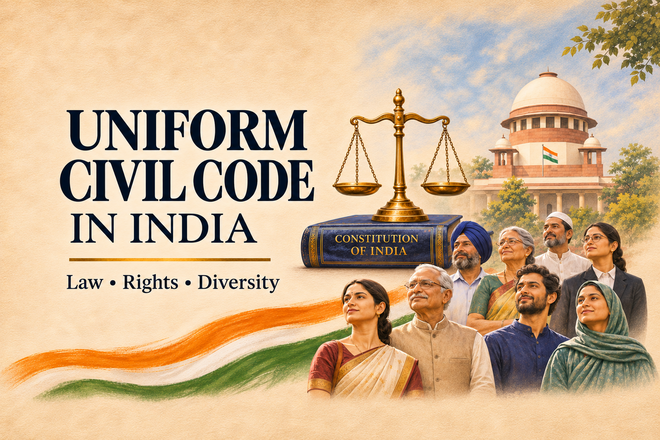
The repeated promise by the top brass of the Bharatiya Janata Party—especially on the eve of parliamentary and assembly elections — that a Uniform Civil Code would be implemented across India apparently sounds somewhat progressive and forward-looking.
However, this issue raises a counter question: how should uniformity be defined? And by that logic, why should there be no pan-India Uniform Criminal Code, which is much more essential for the governance of the country?
The latest announcement in this regard was made by Union Home Minister Amit Shah on October 30 while addressing UP BJP working committee meeting in Lucknow, where he claimed that the party would, like several other states administered by it, enact UCC once voted back to power in Uttar Pradesh next year. It is interesting to note that the saffron party steps up the momentum on this issue whenever it finds itself on the backfoot.
Only on September 13, 2026 he had in a Press conference in Mumbai announced that Uniform Civil Code would come into force in all the 21-Bharatiya Janata Party-led National Democratic Alliance-ruled states before 2029 parliamentary election.
Curiously, Amit Shah’s declaration in Mumbai coincided with the result of the two-phase urban local bodies poll (held on September 9 and 11) in Rajasthan, where the Uniform Civil Code became an election issue, forcing the government to exclude the Scheduled Tribes from the Bill before introducing it in the state Assembly on August 21. Rajasthan has about 13.5% tribal population. Yet BJP had to face stiff resistance to win by much thinner majority. Deputy Chief Minister Diya Kumari had to face the anger of supporters of Savarna Samaj, an upper-caste outfit, on September 11 outside a polling station in Jaipur as they demanded rollback of the Uniform Civil Code.
Almost similar promise was made in Jharkhand by Prime Minister Narendra Modi ahead of the Assembly election of November 2024. Here too assurance was made to 26% Adivasis that they would not come under this purview. The BJP, however, suffered humiliating defeat there, so no effort could be made in this direction.
Another question is: if such a sizeable chunk of citizens—Scheduled Tribes form 8.6% of India’s population—are not included then how can it be called Uniform Civil Code? Besides, where is the uniformity when states have been asked to enact their own different laws. This is likely to cause complications.
Chasing a Chimera
In this era of legal pluralism where states, not only in India, but in the United States (and several other countries), have been allowed to enact different laws, thinking of codifying and implementing Uniform Civil Code amounts to chasing a chimera. The issue is raised time and again by the BJP bigwigs keeping in mind the political objective. Otherwise, codifying it is easier said than done.
But there is no denying the fact that the absence of Uniform Criminal Code is posing a bigger challenge to the society than the non-enactment of Uniform Civil Code. In the name of enacting laws states are sometimes crossing the limit, especially on the issue of the eating habits of different communities. For instance, beef eating is a crime in some states while not in several others, even ruled by the Bharatiya Janata Party or its allies.
Prohibition in a couple of states exposes another contradiction. Following the Article 47 of the Directive Principles of Constitution states like Gujarat and Bihar implemented prohibition. But if it is good for the people of the country as such why not all the other states implemented it? So, a person will go to jail if he or she takes liquor on the eastern bank of River Karmanasa in Bihar’s Buxar district; on the other hand he or she can guzzle down as much as possible just a few metres across this river in Ghazipur district in Uttar Pradesh. Similarly, in dry Gujarat one is not expected to even take a peg of liquor, whereas all sorts of intoxicating drinks flow like anything in neighbouring Maharashtra, Madhya Pradesh and Rajasthan. The tourist spot of Udaipur, a city in south Rajasthan attracts a lot of booze lovers from near-by Gujarat.
Without debating the success or failure of Gujarat and Bihar in implementing liquor ban, one can not deny the fact that thousands of people are languishing in jails for violating prohibition. If Article 44 of Directive principles of Constitution (which calls for the Uniform Civil Code) is so important than why not Article 47 which says: “…The State shall regard the raising of the level of nutrition and the standard of living of its people and the improvement of public health as among its primary duty and , in particular, the State shall endeavour to bring about prohibition of the consumption except for medicinal purposes of intoxicating drinks and of drugs which are injurious to health.”
Then why are Union minister Jitan Ram Manjhi, several media-persons and even economists are openly opposing prohibition and in process questioning the wisdom of the Constitution-makers?
The basic argument is that Bihar and Gujarat suffer the loss of huge amount of revenue generated through excise duties. It is also argued that while small fish are caught the big and powerful ones go scot-free. According to this logic the states would not progress due to lack of revenue worth thousands of crores of rupees annually.
Violators at the Top
While civil servant trainees in Lal Bahadur Shastri National Administrative Academy, Mussoorie in Uttarakhand can take alcohol, they can not touch it once they are posted in these two states, where they have to see that prohibition is followed. As per the law in Gujarat and Bihar these officials will be violators of law and will land in jail if they ever drink and would be treated like criminals.
What about former Chief Justice Ranjan Gogoi who in his autobiography narrated how he took other four judges of the Supreme Court to a hotel for a dinner and wine party after passing the Ayodhya judgement on November 9, 2019.
The hotel was no doubt in Delhi and not in Gujarat or Bihar—otherwise they would have been languishing in jail.
US Story
Not only in India, in the United States—from where we love to borrow ideas–there is no uniformity in criminal laws, not to speak about civil code. There are different laws on abortion, same sex marriage, gun control etc in different states. In the last Presidential election these issues were hotly debated.
It needs to be mentioned that the champions of Federalism are of the view that apart from foreign policy, defence, communication and currency, the rest of the subjects should be left in the hands of the states. The United States is an example of a federal country. In such a situation one can not expect uniformity be it in criminal or civil matters.
So, if there is no uniformity in criminal code which is more important and vital for any country how can it really implement Uniform Civil Code? On paper it can certainly claim to have one.
Anyway, the government can one way or the other legislate a law, but implementing it is a challenging task. For example, in India taking and giving dowry are unlawful acts. Yet, according to the National Crime Records Bureau data on an average every day 16 dowry-related deaths take place in India. In 2024 alone, 5,737 young brides died unnatural deaths. Yet our rulers have no idea to tackle this social menace.
(Soroor Ahmed, an independent journalist formerly associated with The Times of India and Asian Age, is the author of the book The Jewish Obsession, published in 2004. The views expressed is author’s own.)